
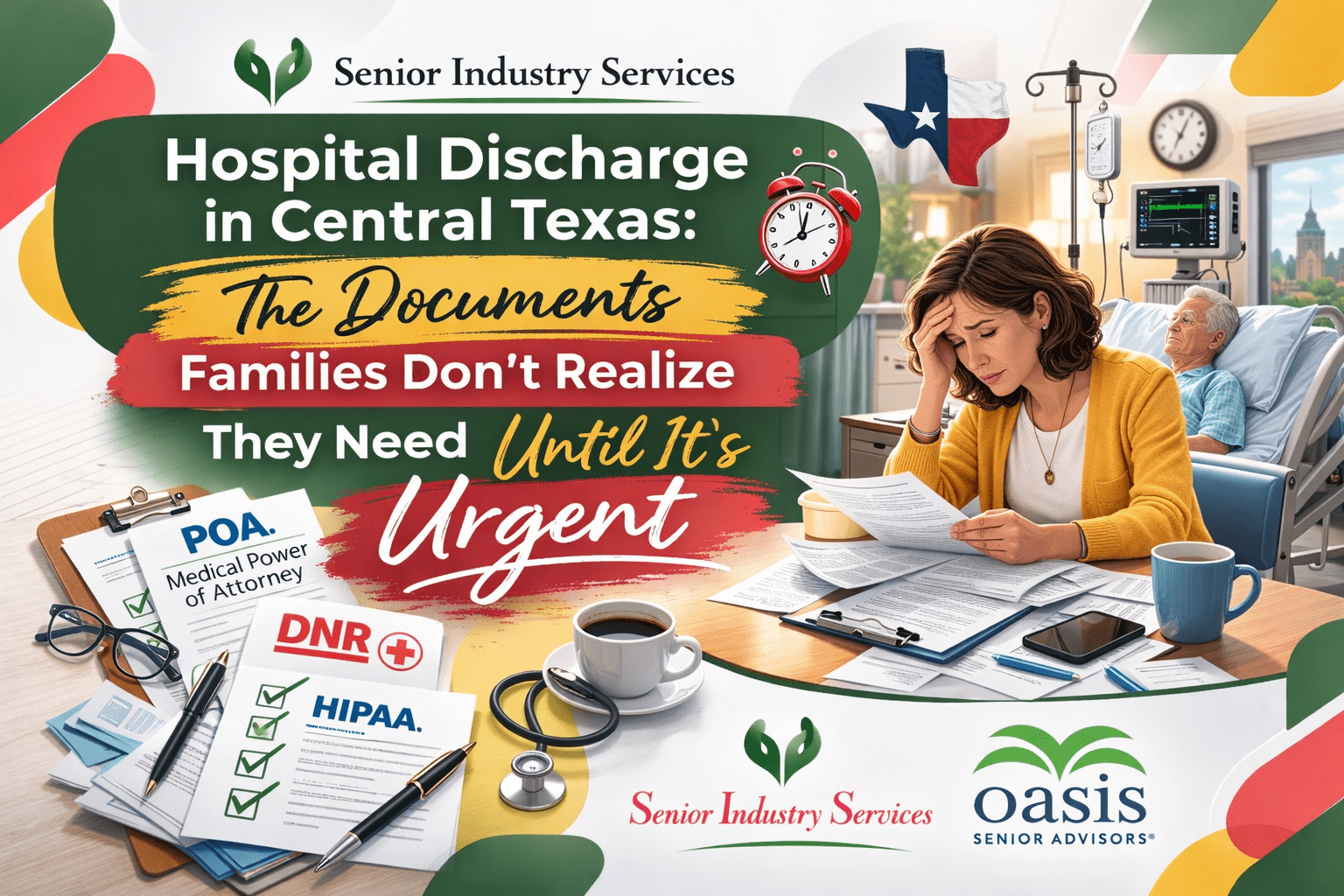
A practical guide to POA, DNR, HIPAA forms, and what families need before transitioning from hospital to home or care.
When everything suddenly feels urgent
A daughter in Austin recently called from a hospital room trying to understand what needed to happen before her dad could be discharged.
She had a stack of forms in front of her, a nurse asking questions, a case manager talking about next steps, and one thought:
“I don’t want to get this wrong.”
If that sounds familiar, you are not alone.
Across Central Texas—from Austin to Round Rock, Georgetown to New Braunfels—families often find themselves making important decisions while also trying to understand paperwork, timelines, and what must be in place before a safe transition can happen.
Why this moment is harder than it should be
The challenge is not just the medical event. It is everything happening around it:
- paperwork
- timing
- communication
- decision-making
Many families assume they can complete documents later. In reality, key forms and authorizations often affect what can happen next, who can help, and how smoothly the transition goes.
Research in healthcare and aging consistently shows that while many families begin advance care planning, far fewer complete critical documents like Power of Attorney before they are needed.
-This isn’t just paperwork—it affects care, access, safety, and decision-making.
The most important documents families should think about
1. Power of Attorney (POA)
Allows a trusted person to make decisions if your loved one cannot.
Why it matters:
- Helps families coordinate care and finances
- Prevents delays in urgent decisions
- Without it, next steps may involve legal processes
Must typically be completed while your loved one is still alert and able to sign.
2. Advance Directive / Living Will
Documents your loved one’s wishes for medical care.
Why it matters:
- Guides providers during serious situations
- Reduces uncertainty and stress
- Aligns care with your loved one’s wishes
3. DNR (Do Not Resuscitate Order)
Clarifies preferences regarding life-saving measures.
Why it matters:
- Ensures wishes are honored during emergencies
- May require a specific form depending on the setting (hospital vs. out-of-hospital)
- Important to review before transitioning to home, rehab, or a senior living community
4. HIPAA Authorization & Medical Access
Allows providers to share information with family.
Why it matters:
- POA does not always guarantee access to records
- Patient portals often require separate proxy access
- Without this, families may not receive updates or test results
This is one of the most common gaps families experience.
5. Discharge & Admission Paperwork
Required for transitions to:
- rehab (IPR)
- skilled nursing (SNF)
- assisted living or memory care
Why it matters:
- Often required before a transition can occur
- Missing documents can delay discharge
Medication & Care Instructions
One of the most critical (and often overlooked) areas.
Healthcare studies show that medication discrepancies are common during discharge, meaning what a patient was taking before and what is listed after hospitalization may differ.
- Careful review helps prevent complications after transition.
What helps most before discharge
If you are preparing for discharge:
- Ask early which documents will be needed
- Confirm who is authorized to sign
- Ensure your loved one is alert before completing forms
- Review medications carefully
- Confirm how records and follow-up results will be shared
- Ask about DNR, HIPAA release, and portal access requirements
- Small steps early can prevent major stress later.
Hospital to Home Checklist
📄 Documents
[ ] Power of Attorney completed or reviewed
[ ] Advance Directive / Living Will reviewed
[ ] DNR discussed and correct form in place
[ ] Discharge paperwork signed
[ ] Admission paperwork ready for next level of care
Access & Communication
[ ] HIPAA authorization completed
[ ] Proxy / patient portal access confirmed
[ ] Follow-up appointments scheduled
[ ] Point of contact identified
Medications & Care
[ ] Updated medication list received
[ ] Changes clearly explained
[ ] Prescriptions filled or arranged
[ ] Care instructions reviewed
Next Steps
[ ] Discharge destination confirmed
[ ] Transportation arranged
[ ] 48–72 hour support plan in place
[ ] Questions about care options answered
You don’t have to figure this out alone
At Senior Industry Services (SIS), we help families across Central Texas understand what’s needed and connect them with trusted local resources.
Because discharge is not just about leaving the hospital—it’s about making sure the next step is safe, clear, and sustainable.
When you’re ready for support
If your family needs help navigating next steps, coordinating documents, or exploring care options, Oasis Senior Advisors can step in with personalized guidance and support.
Serving Central Texas
Austin • Round Rock • Georgetown • Cedar Park • Pflugerville •
Lakeway • San Marcos
Contact
Senior Industry Services (SIS)
512-827-1292
https://seniorindustryservices.com
Additional Resources
- National Institute on Aging – Advance Care Planning
- Medicare.gov – Discharge Planning
- Texas Health & Human Services – Advance Directives
- (You can hyperlink these on your site—great for SEO authority)
Where to Find the Official Texas Forms
Families often ask:
“Where do we actually get the right documents?”
The State of Texas provides official versions of these forms through Texas Health and Human Services and related agencies. Using the correct forms helps ensure they are recognized by hospitals and care providers.
Medical Power of Attorney (MPOA)
This form allows you to designate someone to make healthcare decisions on your behalf if you are unable to do so.
- Access the official form here:
https://www.hhs.texas.gov/regulations/forms/advance-directives/medical-power-attorney-designation-health-care-agent-mpoa
Statutory Durable Power of Attorney (SDPOA)
This document allows someone to handle financial and legal matters, such as paying bills or managing accounts. It does not cover medical decisions.
- Access the official form here:
https://www.hhs.texas.gov/regulations/forms/advance-directives/statutory-durable-power-attorney-sdpoa
Out-of-Hospital DNR (Do Not Resuscitate)
This form communicates your wishes regarding life-saving measures (such as CPR) outside of a hospital setting.
- Access the official form here:
https://www.dshs.texas.gov/sites/default/files/emstraumasystems/DNR/pdf/DNR_Form.pdf
Important to know
While these forms are available online, many families still find it challenging to know:
- When each document is needed
- Who should sign and when
- How to complete them correctly during a hospital stay
- How to ensure they are available and honored at discharge
- That’s where guidance and coordination can make a big difference—especially when timing matters.
These forms are provided by the State of Texas, and families may wish to consult with a qualified professional if they have questions about how to complete them or which documents are appropriate for their situation.
Disclaimer
This information is provided for general educational purposes only and is not intended as legal, medical, or financial advice. Every situation is unique. Senior Industry Services and Oasis Senior Advisors do not provide legal services. Please consult with a qualified professional for guidance specific to your situation.