
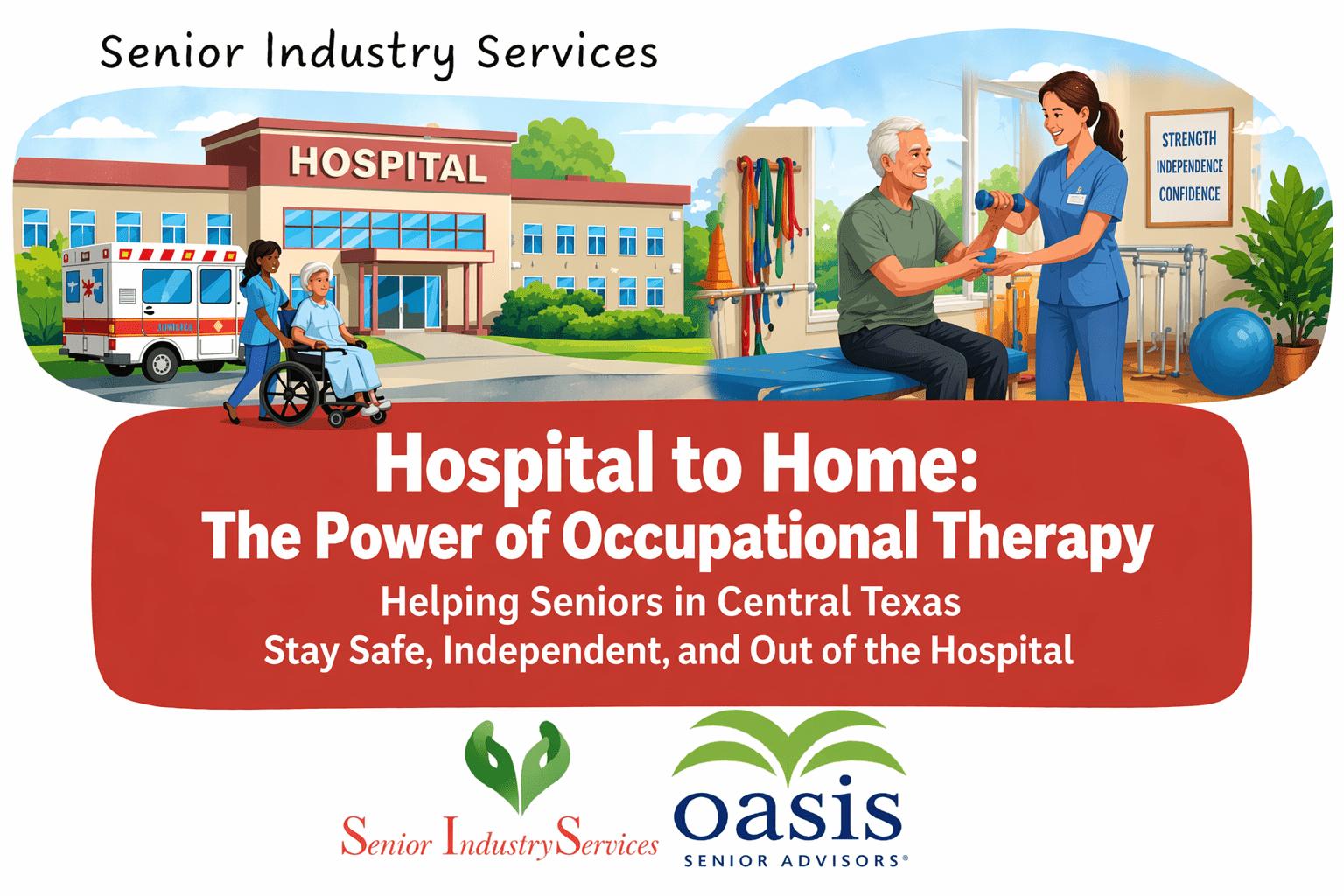
April is Occupational Therapy Month—but for families navigating a hospital stay, this isn’t just a seasonal topic.
It’s often the difference between a safe return home and a stressful, preventable readmission.
Across Central Texas—from Austin and Round Rock to Georgetown, Kyle, Temple, and Waco—families are making fast decisions at discharge. In many cases, one critical piece of the plan is either overlooked or not fully understood: Occupational Therapy (OT).
The Reality After a Hospital Stay
For older adults, the transition from hospital to home is one of the most vulnerable periods in their care journey.
Conditions such as heart failure, pneumonia, hip fractures, or general frailty can significantly impact a person’s ability to function safely at home.
Even routine activities can become difficult or dangerous:
- Getting in and out of bed
- Bathing and dressing
- Preparing meals
- Managing medications
- Walking safely without falling
Functional decline—not just medical condition—is one of the leading drivers of hospital readmissions.
What Occupational Therapy Does at Discharge
Occupational Therapy focuses on helping individuals safely perform the activities of daily living required for independent life.
At discharge, OT evaluates how a person will function in their real-world environment and helps prepare both the patient and their family for what comes next.
Typical OT involvement includes:
Comprehensive Functional Assessment
Evaluation of daily activities such as bathing, dressing, toileting, medication management, cognition, balance, and fall risk.
Home Safety Planning
Identification of environmental risks and recommendations for modifications such as grab bars, improved lighting, removal of hazards, and adaptive equipment like shower chairs or raised toilet seats.
Patient and Caregiver Training
Education on safe transfers, fall prevention, energy conservation, and hands-on guidance so families feel prepared rather than overwhelmed.
Discharge Recommendations
Clinical input on whether a patient can safely return home, needs home health services, or would benefit from additional support such as rehabilitation or a higher level of care.
Transition Support
Coordination with home health services and community resources to maintain progress after discharge.
This is where Occupational Therapy becomes critical in Hospital-to-Home planning across Central Texas health systems like St. David’s HealthCare, Ascension Seton, Baylor Scott & White Health, CHRISTUS Health, and Dell Seton Medical Center at The University of Texas.
It also plays a key role in discharge planning from inpatient rehabilitation hospitals (IPRs) such as Encompass Health and PAM Health, where the focus is on restoring function and preparing patients for the safest possible next step.
The Evidence Behind Occupational Therapy
Research consistently shows that Occupational Therapy improves outcomes and reduces risk after discharge.
- A 2022 meta-analysis of more than 16,700 patients found that adding OT discharge planning reduced 30-day hospital readmissions by 53 percent
- Medicare data analysis (Rogers et al.) found that higher spending on Occupational Therapy was the only service consistently associated with lower readmission rates across major conditions
- Cancer patients receiving inpatient OT were 33.5 percent less likely to be readmitted within 30 days
- Patients receiving more than seven combined OT and PT sessions had a 14 percent lower risk of readmission or death
- Seniors dependent in three or more activities of daily living have significantly higher readmission risk, which OT directly addresses
- OT-led home safety interventions reduce falls by 32 percent, according to CDC STEADI guidelines
These outcomes translate into fewer complications, lower healthcare costs, and more time spent safely at home.
Why This Matters for Families
Hospital discharge often comes with uncertainty.
Families are expected to quickly absorb instructions, coordinate care, and ensure safety—often without a clear understanding of what daily life will look like once their loved one returns home.
Occupational Therapy helps bridge that gap.
With OT involvement, families gain:
- Clear expectations for daily care needs
- Practical strategies to prevent falls and injury
- Confidence in how to safely assist their loved one
- A better understanding of whether home is truly the safest option
For seniors, the benefits are just as important:
- Greater independence
- Improved confidence in daily routines
- Increased safety in the home
- A higher likelihood of aging in place successfully
Questions to Ask Before Discharge
If your loved one is in the hospital or rehab, these questions can help ensure a safer transition:
- Has Occupational Therapy evaluated their ability to function at home?
- What specific risks should we expect after discharge?
- What equipment or home modifications are recommended?
- Should we arrange for home health Occupational Therapy?
- Is returning home the safest option, or should we consider additional support?
These questions can significantly change the outcome of a discharge plan.
When Occupational Therapy Is Especially Important
Families should strongly consider OT involvement if their loved one:
- Has experienced a recent fall
- Needs help with bathing, dressing, or mobility
- Shows signs of confusion or memory changes
- Is physically weaker than before hospitalization
- Lives alone or has limited support
- Is being discharged quickly after a short hospital stay
These are common situations across Central Texas and are exactly where Occupational Therapy can have the greatest impact.
A Better Hospital-to-Home Transition
Hospitals operate on timelines. Families operate on emotion and uncertainty.
Occupational Therapy provides a structured, practical bridge between the two.
It transforms discharge from a rushed event into a safer, more thoughtful transition—one that supports both the patient and the family.
Final Thoughts
Occupational Therapy is not an optional extra in the discharge process.
It is a critical component of keeping seniors safe, reducing readmissions, and supporting long-term independence.
For families across Central Texas, understanding and requesting OT involvement can make a meaningful difference in both outcomes and peace of mind.
About the Author
John Brown, CSA
Owner, Oasis Senior Advisors Austin & Central Texas
Founder, Senior Industry Services of Central Texas
Helping families across Central Texas make informed, confident decisions about senior care, housing options, and the transition from hospital to home.
Sources
- Lockwood & Porter (2022) Meta-analysis on Occupational Therapy and readmissions
- Rogers et al. Medicare hospital spending study
- American Occupational Therapy Association
- Centers for Disease Control and Prevention STEADI Fall Prevention Program