
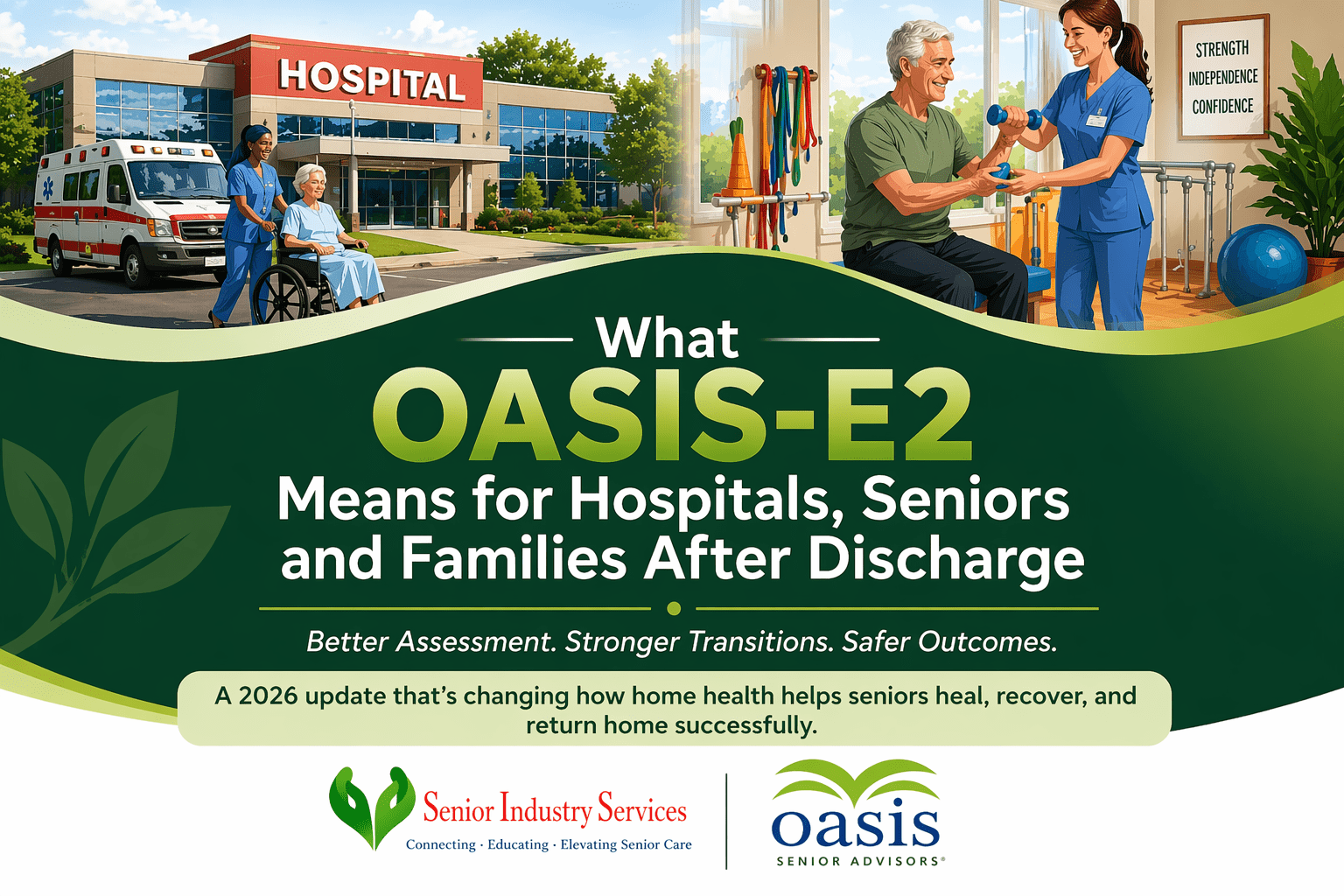
When a senior leaves the hospital, the discharge decision can shape everything that follows.
With OASIS-E2 now in effect as of April 1, 2026, home health agencies and discharge teams have updated how they document transportation needs, communication barriers, and other care details that affect what happens after a hospital stay. For families across Austin and Central Texas, that means the hospital-to-home transition is becoming more detailed and, in some cases, more complicated.
What Is OASIS-E2?
OASIS-E2 is the updated federal assessment used by Medicare-certified home health agencies to document a patient’s condition, function, support needs, and care planning at key time points. CMS made the final OASIS-E2 instruments effective April 1, 2026, and the accompanying guidance manual explains the updated item set and instructions for agencies.
In plain English, OASIS-E2 helps home health teams build a clearer picture of a senior’s:
- Medical condition
- Mobility and daily functioning
- Cognitive and communication needs
- Living situation and support needs at home
One important part of this is Resumption of Care (ROC), which is the assessment completed when home health restarts after a hospital stay. CMS’s OASIS-E2 change materials show that the new version expands or updates several items collected at Start of Care and ROC, including transportation, hearing, vision, and language/interpreter needs.
What Changed in OASIS-E2?
CMS’s official change table shows several updates that matter in real life after discharge:
- A1255 Transportation was added to replace A1250, and it is collected at Start of Care and Resumption of Care.
- B0200 Hearing was added at Start of Care and Resumption of Care.
- The updated item set also includes expanded attention to vision and language/interpreter needs in the revised instrument and guidance.
- The COVID-19 vaccination item O0350 was removed in OASIS-E2.
These changes do not just affect paperwork. They affect how clearly teams identify barriers that can derail recovery once a senior gets home.
Why This Matters at Hospital Discharge
Hospital discharges already move fast. Families are often making major decisions while exhausted, emotional, and short on time.
OASIS-E2 puts more emphasis on documenting issues that often make or break a discharge plan, especially after a hospitalization. Transportation problems, hearing changes, vision limitations, and communication barriers can all affect whether a senior can safely follow through with medications, appointments, therapy, and care instructions once they get home. CMS specifically built these changes into the OASIS-E2 instrument and guidance for 2026.
For families in Central Texas, that matters because the real question is rarely just, “Can they go home?”
The better question is:
Will this plan actually work once they get home?
Positive Impacts for Seniors and Families
When implemented well, OASIS-E2 can help in meaningful ways.
Earlier identification of barriers
Because transportation, hearing, and other communication-related needs are now more directly captured, home health teams have a better chance of spotting issues before they turn into missed visits, medication mistakes, or follow-up failures.
Better continuity of care
More complete and more structured documentation can improve communication between the hospital, the home health agency, and the family. CMS’s guidance and change table reflect that the revised items are intended to improve the quality and consistency of data collected after discharge.
Better matching to the right level of support
When risks are identified more clearly, families have a better chance of recognizing when home health may be enough and when a higher level of support may be safer.
Challenges Families May Still Experience
Even good documentation does not automatically create a smooth transition.
More moving parts
A more detailed assessment can mean more training, more coordination, and more chances for delay while agencies adapt. CMS published both a new guidance manual and a change table specifically to support agencies through this implementation.
Gaps between planning and execution
A care plan may look solid on paper, but families can still face delayed starts of care, confusion about next steps, or support that does not fully line up once the senior is back home. That is not a contradiction. It is the difference between documentation and daily life.
More stress on families
When families are already overwhelmed, more detailed discharge-related questions can feel like one more layer of pressure, even when the extra detail is clinically helpful.
What This Means for Central Texas Families
From Austin and Round Rock to Georgetown, San Marcos, Temple, and New Braunfels, families often have to decide quickly between:
- Home with support
- Home health
- Rehab or skilled nursing
- Assisted living
- Memory care
- Another supportive setting
OASIS-E2 helps make hidden risks more visible. That is helpful. But it also means families may uncover problems sooner, such as transportation gaps, communication limitations, caregiver strain, or changes in functioning that make a quick return home less realistic. CMS’s 2026 OASIS-E2 materials support that this updated assessment is designed to capture those issues more clearly at key post-hospital time points.
Where Families Often Get Stuck
These are the kinds of questions families ask every week:
- “We thought home health was starting. Why hasn’t anyone come yet?”
- “Do we really have enough help at home?”
- “What happens if this plan doesn’t work after a few days?”
Those are not just documentation problems. They are Hospital-to-Home reality problems.
How Oasis Senior Advisors Supports Hospital-to-Home Decisions
Oasis Senior Advisors Austin and Central Texas helps families quickly evaluate whether returning home is truly safe—or if assisted living, memory care, skilled nursing, or another level of support may lead to a more stable and successful recovery.
We support families during and after discharge by helping them:
- Evaluate whether home is realistic and safe
- Compare care options based on actual needs
- Move quickly when timing matters
- Turn a discharge plan into something that works in real life
That matters because better paperwork is helpful, but it still has to be carried out successfully once the senior is home.
How Senior Industry Services Helps Fill the Gap
Senior Industry Services helps serve as the education and connection layer by:
- Explaining changes like OASIS-E2 in plain language
- Helping families and professionals ask better questions
- Connecting people to the right local resources across Central Texas
For families who want added guidance during a hospital-to-home transition, Senior-AI.ai can also serve as a starting point for simple, local education and support options.
Final Takeaway
OASIS-E2 is an important 2026 update. CMS’s final OASIS-E2 materials show that home health agencies now have revised requirements around transportation, hearing, and other communication-related needs that can affect care after a hospital stay.
That is a good thing when it leads to better planning.
But more complete documentation can also make discharge coordination feel more detailed and more complex, especially for families already under pressure.
For families in Central Texas, the takeaway is simple:
A discharge plan should not just look good on paper. It should work in real life.
That is why local guidance matters.
John Brown, CSA
Owner & CEO, Oasis Senior Advisors Austin and Central Texas
Founder, Senior Industry Services
Helping families across Austin and Central Texas navigate hospital-to-home transitions, senior living decisions, and care planning with clarity and confidence.
512-800-1469
senior-ai.ai
Sources & References
- Centers for Medicare & Medicaid Services — OASIS Data Sets (Effective April 1, 2026)
- Centers for Medicare & Medicaid Services — OASIS-E2 Guidance Manual (2026 Update)
- Centers for Medicare & Medicaid Services — OASIS-E2 Change Table (Transportation and Item Updates)
- Industry summaries on OASIS-E2 implementation and home health workflow changes