
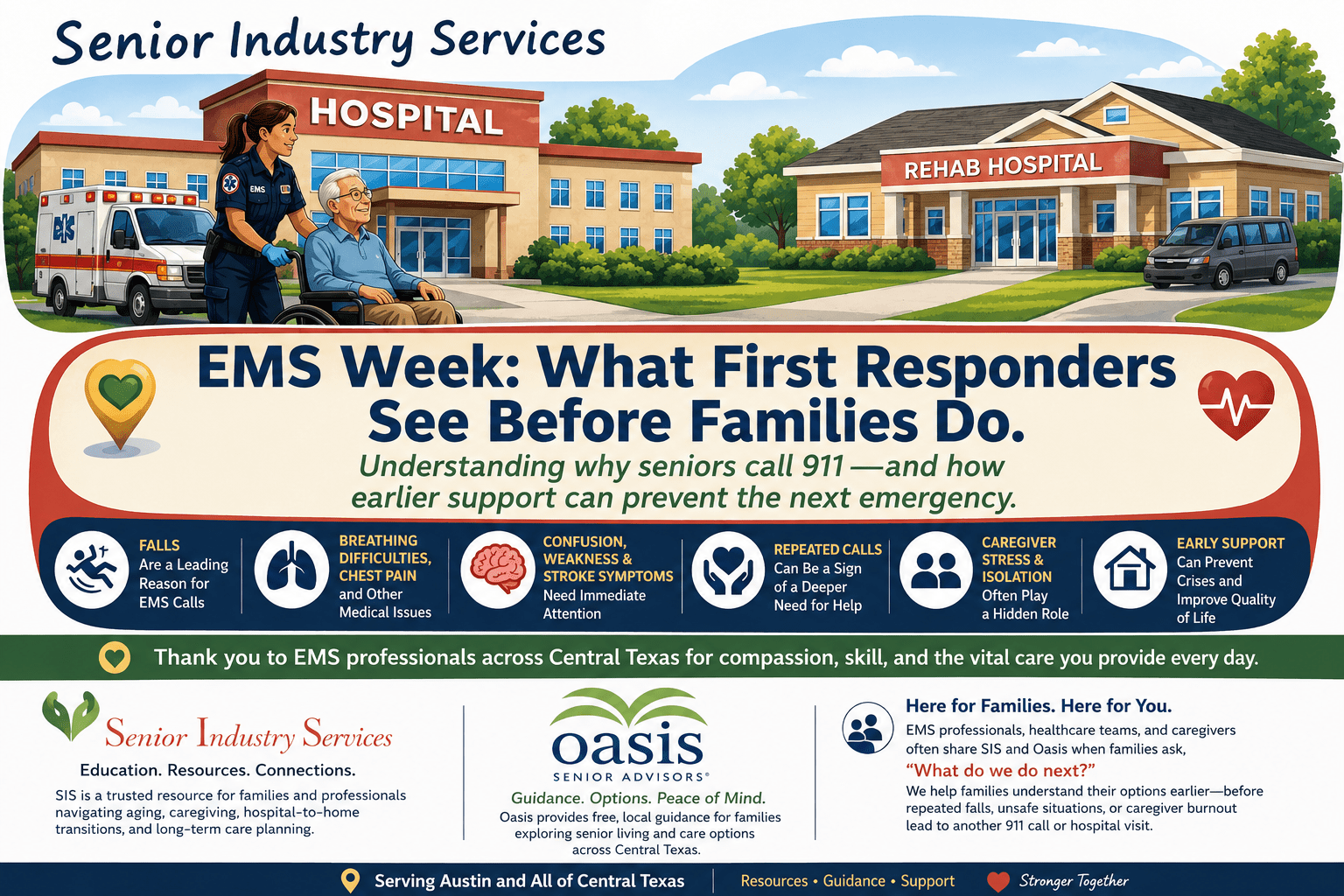
During EMS Week (May 17–23), many people think about ambulances, flashing lights, and medical emergencies.
But for older adults across Central Texas, EMS professionals often see something else long before a true crisis happens: the early warning signs that a senior may no longer be safely aging alone.
Falls. Increasing weakness. Repeated lift assists. Confusion. Difficulty breathing. Fear of falling again. Exhausted caregivers trying to hold everything together.
These situations are far more common than many families realize.
According to the National EMS Information System (NEMSIS), older adults account for nearly 41% of all adult EMS emergency responses in the United States, and approximately one out of every three EMS emergency responses involves an older adult. Adults age 85 and older are also far more likely to arrive at emergency departments by ambulance than younger populations.
Falls Are One of the Biggest Reasons Seniors Call EMS
Falls remain one of the leading reasons EMS is called for older adults.
In a national EMS dataset analyzing adults age 65 and older, falls accounted for 17.4% of EMS-attended 911 calls. Researchers also found that more than 20% of those calls did not result in hospital transport.
Many of these calls happen quietly inside homes, condos, apartments, and senior living communities across Austin and Central Texas.
Sometimes there is no broken bone or dramatic emergency. Instead, EMS crews may find:
- a senior who cannot safely stand alone
- increasing mobility issues
- medication confusion
- dehydration
- worsening weakness
- exhausted caregivers
- repeated lift-assist calls from the same location
The National Council on Aging (NCOA) has also highlighted that many lift-assist calls repeat within days or weeks, showing how often these situations are not isolated incidents but warning signs of larger support needs.
“This Wasn’t Just an EMS Problem Anymore”
A few years ago, our team at Oasis Senior Advisors Austin & Central Texas received a call connected to a senior living alone in a third-floor condo in Central Austin.
EMS had responded multiple times.
The gentleman was increasingly afraid of falling. Leaving the condo had become physically difficult, and eventually it required a two-person assist and chair lift just to help him safely out of the building.
Like many seniors, he wanted to remain independent for as long as possible.
But after repeated EMS responses, it became clear that the situation was no longer safe or sustainable.
The EMS crew recognized something important:
this was no longer only an emergency response issue — it had become a quality-of-life and safety issue.
Our team helped him explore assisted living options that could better support his mobility and daily care needs. We also helped coordinate downsizing resources, moving support, and guidance through the transition from his condo into a safer environment that could properly support his needs.
Most importantly, he was no longer trying to navigate everything alone.
The “Gray Zone” Families Struggle With
Not every 911 call begins as a dramatic emergency.
Many families live in what healthcare professionals often describe as the “gray zone” — situations where an older adult may not seem critically ill, but daily life is quietly becoming unsafe.
That may include:
- repeated falls
- refusing to leave the home
- increasing isolation
- worsening memory loss
- difficulty managing medications
- fear of showering alone
- sleeping in recliners because stairs have become difficult
- caregivers becoming physically or emotionally overwhelmed
EMS professionals often witness these realities before families fully understand how serious the situation has become.
Why Families and Professionals Contact SIS and Oasis
Senior Industry Services (SIS) is a Central Texas senior care resource and education organization focused on helping families and professionals navigate aging, caregiving, hospital-to-home transitions, long-term care planning, and local senior resources.
Oasis Senior Advisors Austin & Central Texas provides free local guidance to families exploring assisted living, memory care, care homes, independent living, skilled nursing, and other senior care options across Central Texas.
Together, SIS and Oasis often help families who are beginning to experience:
- repeated falls
- mobility decline
- caregiver exhaustion
- increasing confusion or dementia concerns
- unsafe living situations
- repeated EMS or hospital visits
- difficulty navigating next steps alone
Many EMS professionals, caregivers, and healthcare teams share Oasis and SIS when families ask:
“What do we do next?”
Our role is to help Central Texas families understand options earlier — before repeated falls, unsafe situations, caregiver burnout, or another emergency creates an even larger crisis.
Supporting Seniors Before the Next Crisis
At SIS and Oasis, we believe many emergencies can be reduced through earlier conversations, stronger support systems, and better education for families.
That may include:
- fall prevention discussions
- home safety planning
- hospital-to-home support
- senior living guidance
- caregiver education
- respite options
- mobility support resources
- SIS Care Companion AI monitoring services
- planning before another 911 call becomes necessary
During EMS Week, we want to sincerely thank the EMS professionals serving Austin, Round Rock, Georgetown, Cedar Park, Kyle, Buda, San Marcos, New Braunfels, Temple, Waco, and communities throughout Central Texas.
Many times, EMS professionals are not only responding to emergencies — they are witnessing the realities of aging, caregiving, isolation, and mobility decline long before others do.
If you or someone you love is beginning to struggle with mobility, safety, caregiving stress, or repeated EMS calls, SIS and Oasis are here as local Central Texas resources for guidance, education, and support.
Sources & Citations
- National EMS Information System (NEMSIS)
- Centers for Disease Control and Prevention (CDC) – Older Adult Falls Data
- National Council on Aging (NCOA) – Falls Prevention & Lift Assist Data
- Shah MN, et al. EMS utilization by older adults and fall-related EMS calls
- North Carolina Emergency Department EMS Arrival Studies
Written by:
John Brown
Owner & Certified Senior Advisor (CSA®)
Oasis Senior Advisors Austin & Central Texas
Senior Industry Services (SIS)
Serving seniors, families, hospitals, EMS professionals, and healthcare teams across Central Texas with guidance for assisted living, memory care, care homes, nursing homes, hospital-to-home transitions, and long-term care planning.