
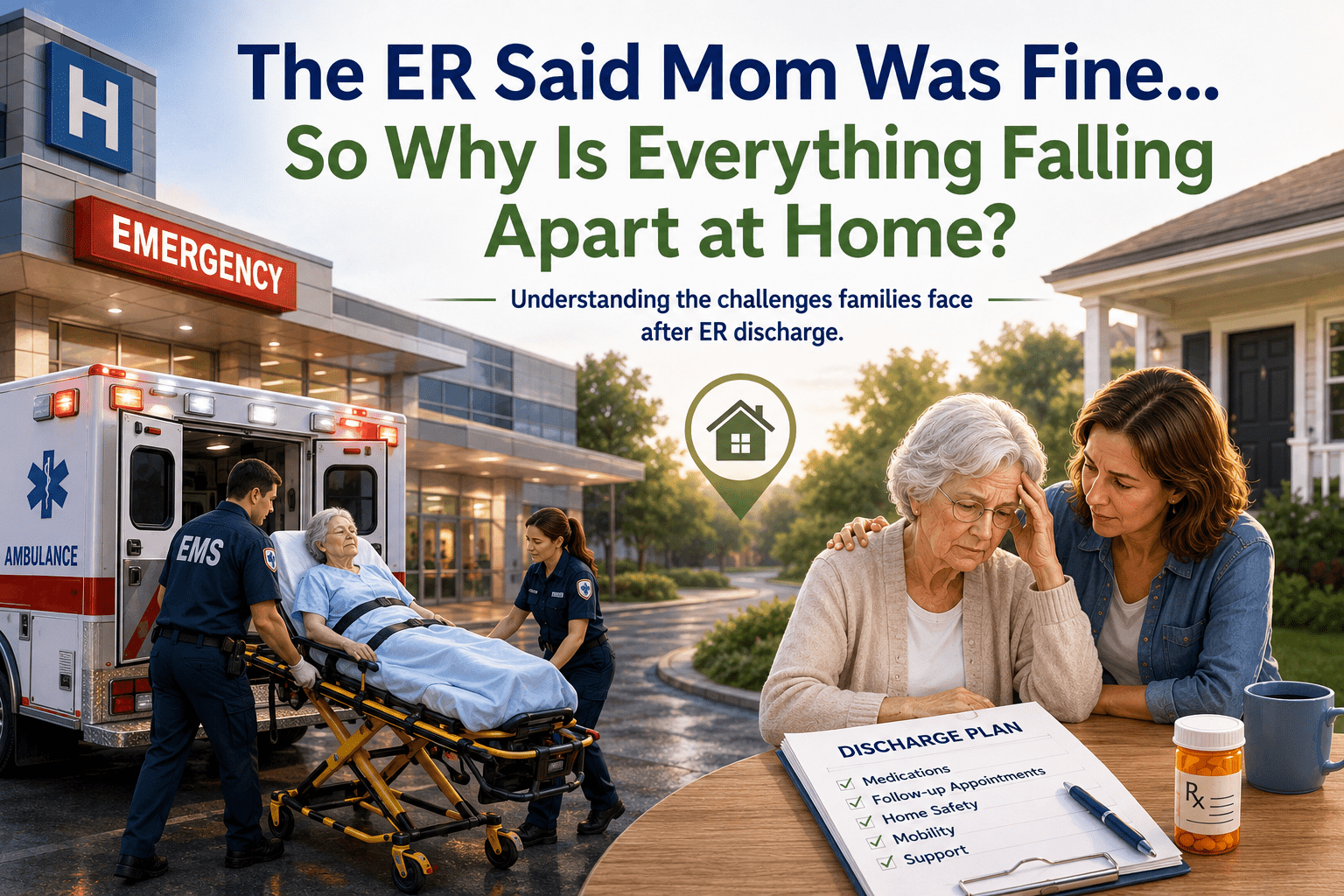
The ER visit was exhausting, but the family felt relieved hearing Mom was medically stable enough to return home.
Then reality hit.
Her medications were confusing. She was weak trying to walk to the bathroom. Meals were skipped. Follow-up appointments became overwhelming. Her daughter was suddenly coordinating physicians, home health, transportation, prescriptions, and work schedules — all while quietly wondering whether Mom was truly safe living alone anymore.
For many families across Austin, Round Rock, Georgetown, Kyle, San Marcos, New Braunfels, Temple, Waco, Cedar Park, Pflugerville, and surrounding Central Texas communities, the hardest part often begins after the ER discharge.
Because medical stability and safe living are not always the same thing.
Why ER Discharge Can Be More Complicated for Older Adults
Emergency Rooms are designed to stabilize acute medical problems. Once an older adult is medically stable, the next challenge often becomes managing the realities of daily life back at home.
That transition can become especially difficult when there are underlying concerns involving:
- Memory Care needs
- Falls or mobility limitations
- Medication management
- Caregiver burnout
- Isolation or living alone
- Difficulty preparing meals
- Transportation challenges
- Missed physician follow-ups
- Cognitive decline or confusion
- Unsafe home environments
Research shows older adults discharged from the Emergency Department often face significant risks during the transition home. One review found nearly 80% of older adults discharged from the ER had at least one unattended health concern, while approximately 44% revisited the ER within six months. Studies also show older adults who receive structured follow-up care after discharge have lower return rates than those who do not receive follow-up support.
The issue is often not a failure of emergency medical care.
The challenge is that once an older adult returns home, families are suddenly left coordinating everything else.
The Hidden Fragmentation Families Experience After Discharge
Inside the hospital or ER, there is structure.
Nurses monitor medications. Meals are provided. Staff help with mobility. Physicians coordinate testing and treatment. Someone notices changes in condition.
At home, that system often disappears overnight.
Adult children suddenly become:
- medication managers
- transportation coordinators
- appointment schedulers
- caregivers
- safety monitors
- financial planners
- advocates
- emotional support systems
Many families quickly realize they are trying to hold together a fragmented care system while also balancing jobs, children, finances, and exhaustion.
This is one reason older adults living alone after hospitalization or an ER visit are especially vulnerable to:
- repeat falls
- medication errors
- dehydration
- poor nutrition
- worsening dementia symptoms
- missed appointments
- caregiver burnout
- social isolation
- repeat ER visits
In many cases, seniors do not return to the ER because the original medical issue was treated incorrectly.
They return because safely managing life at home became too difficult without additional support.
Why Follow-Up and Support Matter
Research has shown older adults who receive outpatient follow-up and structured discharge support after an ER visit experience better transitions and lower revisit rates.
Unfortunately, many families leave the ER already overwhelmed.
Medications may have changed. Mobility may have declined. Follow-up appointments need scheduling. Home health may not yet be coordinated. Family members may disagree about next steps. In some cases, memory concerns or caregiver exhaustion become more obvious only after returning home.
This is why many older adults discharged from the ER continue struggling with:
- safety at home
- medication compliance
- isolation
- mobility limitations
- cognitive decline
- transportation barriers
- long-term care planning
Older adults who live alone or have limited family support are especially vulnerable during this transition period.
When Home May No Longer Be the Safest Option
For many Central Texas families, an ER visit becomes the moment they begin asking difficult questions:
- Is home still safe?
- Can Dad safely manage medications alone?
- Is Mom beginning to show signs of Memory Care needs?
- Are repeat falls becoming a larger pattern?
- Is caregiver exhaustion reaching a breaking point?
- Would Assisted Living, Memory Care, Care Homes, Skilled Nursing, home care, or additional monitoring support improve safety and quality of life?
These conversations are emotional and deeply personal.
They are also increasingly common as families across Central Texas try to navigate the growing complexity of aging, caregiving, hospital-to-home transitions, and long-term care planning.
You Are Not Alone in Navigating the Next Step
Across Austin, Round Rock, Georgetown, Temple, Kyle, San Marcos, New Braunfels, Waco, Bastrop, Marble Falls, Cedar Park, and surrounding Central Texas communities, many families discover the most difficult part begins after discharge — when they are suddenly responsible for coordinating everything alone.
Oasis Senior Advisors Austin & Central Texas helps families explore local options for Assisted Living, Memory Care, Care Homes, Independent Living, Skilled Nursing, hospital-to-home transitions, long-term care planning, and senior support resources throughout Central Texas.
Sometimes families simply need reassurance and education.
Other times, they realize additional support may now be necessary to help an older adult remain safe, supported, and connected.
The first step is often simply having a conversation.
Free Resource: Planning for Your Discharge Guide
Returning home after a hospital stay or ER visit can feel overwhelming for older adults and their families. Our free guide was created specifically for Central Texas families navigating hospital-to-home transitions, senior care decisions, follow-up planning, and discharge safety concerns.
Inside the guide, you’ll find:
- Questions to ask before discharge
- Medication and follow-up reminders
- Fall and home safety considerations
- Signs additional support may be needed
- Guidance for Memory Care, Assisted Living, Care Homes, Skilled Nursing, and home support options
- Local Central Texas senior care resources
Download the Free Discharge Planning Guide : https://drive.google.com/file/d/1PdeN0C_oyEpxqdB7ABxIBgmzv-aBv-EP/view
Sources & Research
- Centers for Disease Control and Prevention (CDC): Emergency Department Visits Among Adults Age 60 and Older
- American College of Emergency Physicians (ACEP) Geriatric Emergency Department Guidelines
- PubMed: Association of Geriatric Emergency Department Post-Discharge Care With Outcomes
- PubMed: Effectiveness of a Care Transitions Intervention for Older Adults Discharged From the Emergency Department
- National Institutes of Health (PMC): Poor Outcomes After Emergency Department Discharge of the Elderly
- National Institutes of Health (PMC): Emergency Department-to-Community Transitions of Care
- AHRQ PSNet: Early Death After Emergency Department Discharge
About the Author
John Brown, CSA®, is the Owner and CEO of Oasis Senior Advisors Austin & Central Texas and Founder of Senior Industry Services (SIS). He works with families, hospitals, rehab teams, physicians, EMS professionals, and healthcare providers across Central Texas to help navigate Assisted Living, Memory Care, Care Homes, Skilled Nursing, hospital-to-home transitions, long-term care planning, and local senior care resources.
Oasis Senior Advisors Austin & Central Texas provides free local guidance for older adults and families exploring senior living and support options throughout Austin, Round Rock, Georgetown, Kyle, San Marcos, New Braunfels, Temple, Waco, and surrounding Central Texas communities.