
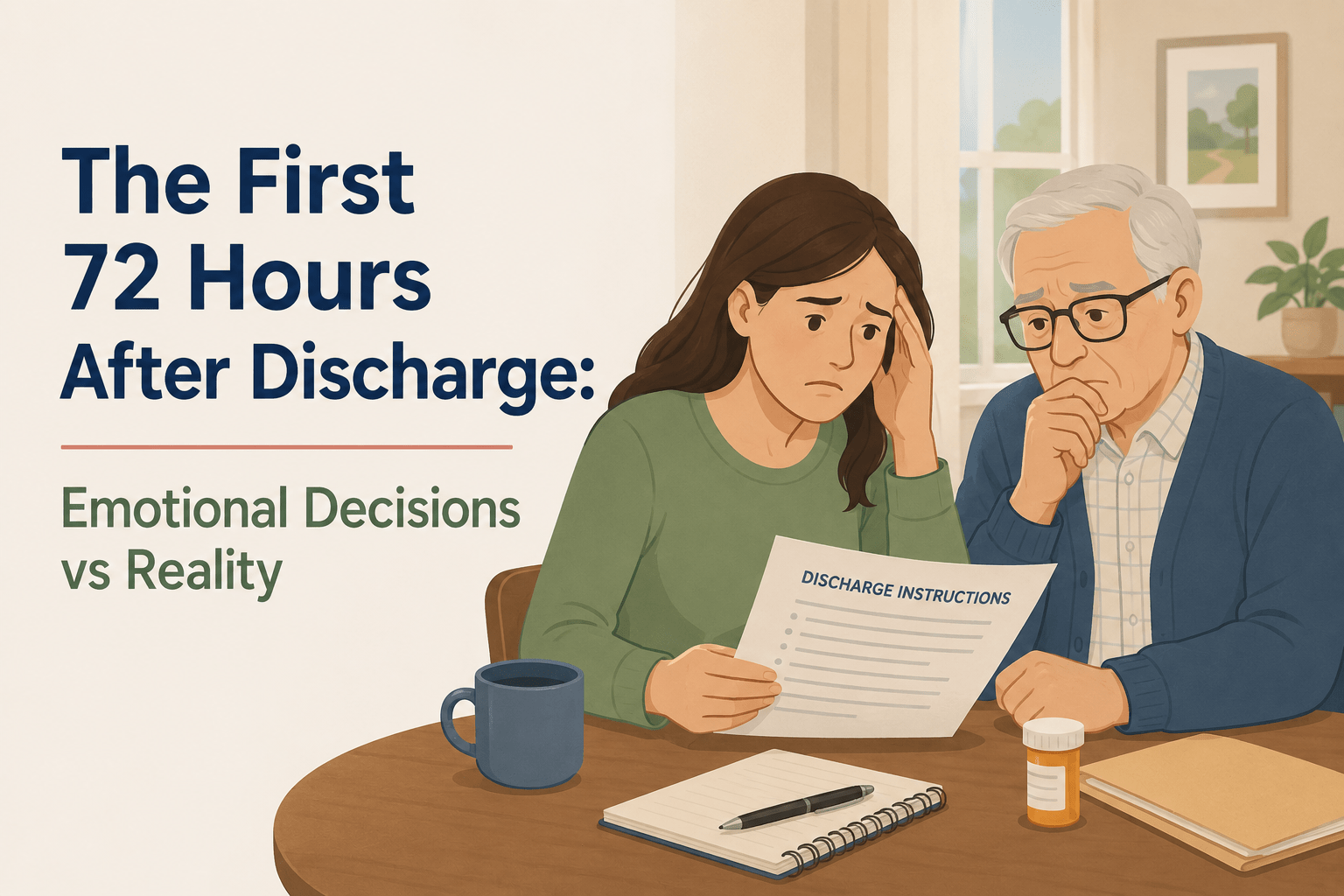
“Dad said he was fine.”
The discharge papers looked complete. The medications were reviewed. Follow-up appointments were scheduled. Everyone wanted to believe home was the right answer.
Three days later, he was back in the emergency room.
This is a story families across Austin, Round Rock, Georgetown, Kyle, San Marcos, Temple, Waco, and throughout Central Texas experience every single day after a hospital discharge.
The first 72 hours after leaving the hospital are often the most fragile part of recovery — not simply because of medical issues, but because families are trying to make major decisions while emotionally overwhelmed, exhausted, and uncertain.
Hospitals move in minutes and hours.
Families move on emotions.
And during those first few days after discharge, emotions can quietly cloud what is actually safe, realistic, or sustainable at home.
Many older adults genuinely believe they are “fine.” Adult children want to respect independence. Spouses are exhausted but afraid to ask for help. Families are often trying to process medication changes, mobility limitations, cognitive decline, fall risks, financial stress, and caregiver responsibilities all at once.
At the same time, hospitalization itself can significantly impact an older adult’s strength, cognition, balance, endurance, sleep, nutrition, and overall function. The person coming home may not be functioning at the same level they were before the hospitalization.
That disconnect is where many families struggle.
What looks safe on paper often feels very different once everyone is home.
The stairs suddenly look steeper.
The bathroom suddenly feels unsafe.
The nighttime confusion becomes more noticeable.
Medications become difficult to organize.
Appointments become overwhelming.
The caregiver who thought they could “handle it” starts running on two hours of sleep.
Research continues to reinforce how difficult these transitions truly are for families. Studies have found 30-day hospital readmission rates among older adults commonly range from 11% to 23%, even when discharge plans appear complete. Other research has shown caregiver burden is directly associated with increased emergency department revisits after discharge.
In other words, emotional overload and caregiver strain are not just stressful — they can directly impact recovery outcomes.
Families often assume a discharge means a senior is fully ready and safe at home. In reality, many patients leave the hospital with unresolved concerns, unanswered questions, reduced mobility, fatigue, or support needs that become more obvious once the structure of the hospital disappears.
This is where many families begin second-guessing themselves.
“Did we bring mom home too early?”
“Can dad safely stay alone?”
“Are we missing something?”
“Is this confusion normal?”
“Can we realistically keep doing this?”
Those are not signs of failure.
Those are signs that the situation may need a deeper reality check.
One of the biggest hidden risks after discharge is that emotionally overwhelmed families often struggle to accurately judge what is truly manageable long term. Seniors may minimize symptoms because they fear losing independence. Adult children may overestimate what they can realistically handle while balancing work, children, finances, and caregiving responsibilities. Spouses may quietly ignore their own physical limitations out of love, loyalty, or fear.
Everyone is trying to protect each other emotionally.
But sometimes that emotional protection delays important conversations about safety, support, and next steps.
At Oasis Senior Advisors Austin & Central Texas, we often tell families:
“What looks safe on paper often isn’t safe once real life starts again.”
That does not mean home is the wrong answer.
It means families deserve honest conversations, realistic planning, and support before a preventable crisis happens.
Sometimes the right answer is additional home support.
Sometimes it is respite care.
Sometimes it is assisted living, memory care, rehabilitation, or skilled nursing.
Sometimes families simply need someone neutral to help them slow down, assess the situation clearly, and reality-test the discharge plan before exhaustion, falls, medication issues, or caregiver burnout create another emergency.
The goal is not to take away independence.
The goal is to create a safer and more sustainable path forward for both the senior and the family.
The first 72 hours after discharge are rarely just medical.
They are emotional, physical, logistical, and deeply human.
And no family should have to navigate that alone.
About Oasis Senior Advisors Austin & Central Texas
Oasis Senior Advisors Austin & Central Texas provides free, local guidance to families navigating assisted living, memory care, independent living, care homes, skilled nursing, and Hospital-to-Home transitions throughout Central Texas. From Austin to Waco, Round Rock to New Braunfels, our team helps families better understand options, care needs, financial considerations, and next steps during some of life’s most overwhelming moments.
For assistance, call 512-800-1469 or visit:
https://www.oasissenioradvisors.com/locations/austin-central-tx/
Sources & Research
- “30-Day Readmission Among Elderly Medicare Beneficiaries”
https://pmc.ncbi.nlm.nih.gov/articles/PMC4888086/ - “Caregiver Burden and 30-Day Emergency Department Revisits”
https://jamanetwork.com/journals/jamanetworkopen/fullarticle/2838645 - “How Family Caregivers and Older Adults Experience Hospital Discharge”
https://pmc.ncbi.nlm.nih.gov/articles/PMC10738681/ - “Assessing Family Caregiver Readiness for Hospital Discharge”
https://pmc.ncbi.nlm.nih.gov/articles/PMC12277104/ - “Patient-Reported Barriers to Discharge Readiness”
https://pubmed.ncbi.nlm.nih.gov/27079295/ - “When AI Colludes: Clinical Reliability of Training and Preference Data as a Trustworthy-AI Criterion”
https://mental.jmir.org/2026/1/e96894