
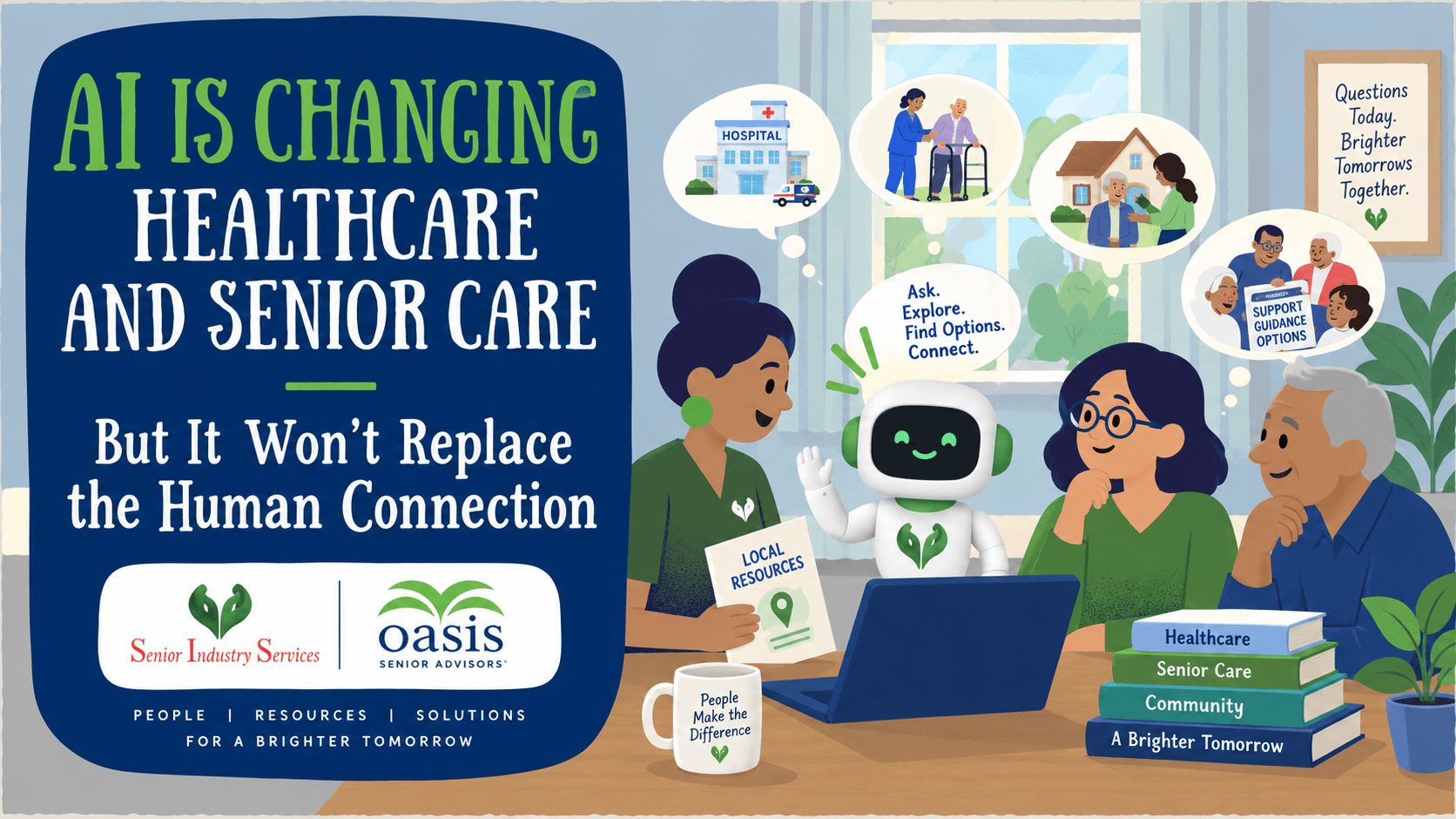
How artificial intelligence is changing the way seniors, families and professionals navigate care — and what Central Texas should be thinking about now
Artificial intelligence isn't something healthcare and senior-care professionals need to prepare for someday.
It is already here.
Hospitals and physicians are using AI. Senior living organizations are investing in it. Healthcare professionals are using it to reduce administrative work, research information and communicate more efficiently. Older adults and caregivers are asking AI questions about health and care.
According to the American Medical Association, 81% of physicians surveyed in 2026 reported using AI professionally — more than double the 38% reported in 2023. Uses include summarizing medical research, documenting visits and creating discharge instructions.
The important question for those of us serving seniors isn't how much AI we can use.
It's:
How can we use AI to make healthcare and senior care easier to navigate without losing the human relationships, professional judgment and trust that good care depends on?
For professionals serving seniors and families across Austin, Round Rock, Georgetown, Temple, Waco, Lakeway, Kyle, San Marcos, New Braunfels and communities throughout Central Texas, that conversation has already begun.
AI Is Already Part of Healthcare
AI in healthcare goes far beyond asking a chatbot a question.
The Centers for Medicare & Medicaid Services (CMS) describes potential uses that include helping physicians analyze symptoms against clinical datasets, complementing human review of imaging and identifying potentially harmful drug interactions. Technology-enabled care can also connect patients with virtual services and provide information to healthcare professionals responsible for their care.
Meanwhile, the AMA's 2026 research shows physicians increasingly using generative AI for everyday tasks such as research, documentation and discharge instructions.
The important word is assist.
AI can help physicians, nurses, social workers, administrators and family caregivers.
Helping someone do their job, however, is very different from replacing their judgment.
Healthcare Has Already Learned Some Expensive AI Lessons
Senior care doesn't have to start from zero.
Healthcare has spent years experimenting with predictive analytics, clinical decision-support tools, machine learning and other forms of AI.
A recent McKnight's Senior Living column argues that many disappointing healthcare AI implementations shared a common pattern: organizations purchased impressive technology before adequately addressing their data, workflows and people.
The technology could work and still fail because employees didn't trust it, data were incomplete or it didn't fit actual workflows.
The author's central lesson is particularly relevant to senior care:
You can't simply add AI to a broken process and expect the process to become better.
The human transformation has to happen alongside the technological one.
That applies to hospitals, rehabilitation providers, skilled nursing facilities, home health, home care, hospice, senior living and virtually every organization serving older adults.
Senior Care Is Next — And In Many Ways, It Is Already Here
Senior living organizations are embracing AI too.
According to the 2025 Argentum Technology Report, 76% of senior living technology and C-suite executives surveyed believed AI would have a positive or transformative impact on their organizations.
But 77% identified interoperability among their top three barriers to technology implementation.
That creates an important contrast: enthusiasm for AI is growing while many organizations are still working to connect the systems and information AI depends upon.
And senior living is only one part of the continuum.
One older adult might interact with a hospital, inpatient rehabilitation, skilled nursing, physicians, home health, home care, hospice, assisted living, memory care, pharmacies, transportation providers, veterans' resources and family caregivers.
The opportunity isn't simply to make one organization more efficient.
It's to make an extraordinarily complicated system easier for humans to navigate.
Imagine One Central Texas Family's Journey
Consider a situation senior-care professionals see every day.
An older adult living in Georgetown falls at home and goes to the hospital.
His daughter suddenly hears terms she has never needed to understand:
Inpatient rehabilitation. Skilled nursing. Home health. DME. Medicare coverage. Prior authorization.
She pulls out her phone and asks AI:
"What's the difference between inpatient rehab and a skilled nursing facility?"
A few weeks later, Dad is in rehabilitation.
Now she's asking:
"How long will Medicare pay for rehab?"
"What happens if Dad can't safely return home?"
"What's the difference between home health and home care?"
Eventually:
"How much does assisted living cost near Georgetown?"
"Does Medicare pay for assisted living?"
"Could Dad qualify for VA Aid & Attendance?"
AI can now be present at almost every stage of that family's journey.
That changes the conversation for everyone working in healthcare and senior care.
Seniors and Families Aren't Waiting for the Industry
Older adults are already using AI.
The University of Michigan National Poll on Healthy Aging found that 55% of adults age 50+ had used technologies incorporating AI that they could speak or type to.
And their questions increasingly involve health.
AARP research published in 2026 found that among adults 50+ who use AI, 41% had already asked an AI-powered tool a health-related question. Another 62% said they were likely to do so during the next 12 months.
Healthcare and senior-care professionals should therefore assume something important:
The person sitting across from us may already have asked AI about the problem before talking to us.
That can be helpful. Families may understand terminology better, discover resources or arrive with better questions.
But they may also arrive with incomplete, outdated or incorrect information presented confidently by an AI system.
That makes professional guidance more important — not less.
Using AI Doesn't Mean Trusting AI
Older adults appear to recognize that distinction.
The University of Michigan found that 92% of adults 50+ wanted to know whether information they received came from a person or was generated by AI.
And 46% reported having very little or no trust in AI-generated information.
AARP's 2026 research found another concern:
69% of adults 50+ said they were uncomfortable sharing personal health information or medical documents with a health-specific generative-AI tool, chatbot or agent.
Concerns included privacy, security, how information would be used and accountability when AI provides incorrect guidance.
Those aren't reasons to abandon AI.
They're reasons to establish boundaries around how we use it.
Privacy Has to Be Part of the Conversation
This is especially important in healthcare and senior care.
Professionals need to understand where information entered into an AI system goes, how it is handled, who may have access and whether the system is appropriate for the information being shared.
CMS emphasizes privacy and security protections, including HIPAA where applicable. Its guidance also warns against entering protected health information or personally identifiable information into publicly accessible AI platforms.
For senior-care professionals, the practical lesson is simple:
Don't assume an AI tool is an appropriate place for protected or confidential information just because it's convenient.
Organizations need clear policies governing which tools employees can use and what information can be entered.
AI Can Assist With Care. Humans Still Need to Own the Decisions.
CMS supports responsible use of AI while emphasizing privacy protections, human oversight of care decisions and ongoing monitoring for accuracy and safety.
That distinction matters.
AI can help identify information. A professional interprets it.
AI can summarize a document. A professional verifies it.
AI can identify resources. A person determines whether they're appropriate.
AI can explain a diagnosis in plain language. A healthcare professional diagnoses and treats the patient.
AI can explain general Medicare rules. It cannot determine an individual's coverage from a general question.
AI can explain assisted living and memory care. It cannot fully understand Mom's personality, finances, medical needs, family dynamics, safety concerns and what feels like home.
AI can inform a decision. It shouldn't automatically become the decision-maker.
Where AI Could Help Across the Senior-Care Continuum
Some of AI's most valuable applications may also be the most practical.
Hospitals and health systems can use it to assist with documentation, research, patient education and administrative workflows.
Skilled nursing and rehabilitation providers can use it to support documentation, communication and education while clinicians retain responsibility for care.
Home health and home care organizations may streamline administrative processes and make information easier for clients and caregivers to understand.
Hospice and palliative-care organizations can use technology to help explain unfamiliar terminology and help families formulate questions — while recognizing that conversations about goals of care, grief and end-of-life decisions require human presence.
Senior living organizations can use AI for administrative processes, communication, research and follow-up.
And elder-law attorneys, financial professionals, advisors, nonprofits, transportation providers, veterans' organizations and other community resources may use AI to reduce repetitive work and improve access to information.
The goal isn't to remove professionals from the process.
It's to help the right professional get involved sooner.
AI May Actually Make Human Relationships More Valuable
There is an interesting paradox developing.
As information becomes easier to generate, trusted human judgment becomes more valuable.
AI can explain dementia in seconds.
It cannot sit with a husband realizing his wife may no longer be safe at home.
AI can explain hospice.
It cannot hold someone's hand.
AI can explain Medicare's general skilled-nursing rules.
It cannot understand every detail of Dad's actual discharge situation.
AI can produce a list of senior living communities.
It cannot walk through those communities with a daughter, understand what matters to Mom and help the family weigh the emotional and practical differences.
Those aren't necessarily shortcomings we need AI to overcome.
They're reminders of why people matter.
So What Should Central Texas Senior-Care Professionals Do?
We don't need to fear AI — and we don't need to chase every AI product that appears.
We need to become good users of it.
Before adopting an AI tool or process, organizations should ask:
What problem are we solving?
Does this make someone's job easier or simply add another platform?
What information are we putting into it, and is that appropriate?
Where did the answer come from, and how will important information be verified?
When does a qualified human need to become involved?
And perhaps most importantly:
Does this technology give our people more time to care for people?
If the answer is yes, we may be headed in the right direction.
Why Senior Industry Services Is Exploring AI
This conversation is particularly important to us at Senior Industry Services (SIS).
Our mission centers on connecting seniors, families, caregivers and healthcare professionals across Central Texas with trusted resources, meaningful relationships and support.
Traditionally, that happens through people: a social worker knowing whom to call, a professional introducing a family to a resource, two people meeting at SIS Just Networking and later helping one another solve a problem.
Those relationships aren't becoming obsolete.
Technology simply gives us another way to connect the dots.
That's why SIS created Senior-AI — to help seniors, families, caregivers and professionals ask senior-care questions, understand terminology and discover resources across Central Texas.
The goal isn't for AI to become the expert in the room.
The goal is to help someone find the right room — and the right person in it.
AI can help explain VA Aid & Attendance, home care versus home health, hospice, senior living options or other unfamiliar subjects. It can help professionals and families discover local resources.
And when the question requires clinical, legal, financial or individualized guidance, technology should help point people toward qualified humans.
AI can help navigate the map. People still make the journey.
The Future Isn't AI Versus People
Artificial intelligence will continue changing healthcare and senior care.
Some applications will prove enormously valuable. Others won't.
Healthcare has already taught us that buying technology isn't the same thing as improving care.
Our opportunity is to use AI thoughtfully:
Use it to make information easier to understand.
Use it to reduce unnecessary administrative work.
Use it to help professionals and families find resources and ask better questions.
Use it to connect people.
And recognize the point where technology should stop and a human being should take over.
Because the future of senior care isn't AI versus people.
It will be determined by how well people use AI to help other people.
Sources & Further Reading
American Medical Association — Physician Survey on Augmented Intelligence (2026)
81% of surveyed physicians reported using AI professionally, more than twice the reported level in 2023.
https://www.ama-assn.org/practice-management/digital-health/physician-survey-augmented-intelligence
Centers for Medicare & Medicaid Services — Technology-Enabled Care and Artificial Intelligence
CMS information about AI applications, privacy, human oversight, accuracy and safety in healthcare.
https://www.cms.gov/priorities-innovation-key-concepts-technology-enabled-care-artificial-intelligence
CMS — Guidance for Responsible Use of Artificial Intelligence
Guidance addressing human oversight, accuracy and handling of PII and protected health information.
https://security.cms.gov/policy-guidance/guidance-responsible-use-artificial-intelligence-ai-cms
Argentum — 2025 Technology Report
Research examining senior living AI adoption, technology priorities and interoperability.
https://www.argentum.org/wp-content/uploads/2025/06/2025-Technology-Report.Final_.pdf
University of Michigan National Poll on Healthy Aging — How Older Adults Use and Think About AI
Research examining AI adoption, trust and attitudes among adults age 50+.
https://ihpi.umich.edu/national-poll-healthy-aging/national-findings/how-older-adults-use-and-think-about-ai
AARP — Older Adults Use AI for Health Questions, But Have Trust Issues (2026)
Research examining health-related AI use, privacy and trust among adults age 50+.
https://www.aarp.org/pri/topics/technology/internet-media-devices/artificial-intelligence-health-tools/
McKnight's Senior Living — What Senior Living Can Learn From a Decade of AI Failure in Healthcare, Before It Repeats It
Industry perspective on data quality, workflows, staff trust and AI implementation.
https://www.mcknightsseniorliving.com/home/columns/marketplace-columns/what-senior-living-can-learn-from-a-decade-of-ai-failure-in-healthcare-before-it-repeats-it/
Central Texas Senior-Care Resources
Senior Industry Services (SIS)
Senior-care resources, professional networking, education and Senior-AI for Central Texas.
https://seniorindustryservices.com/
Senior-AI
Ask senior-care questions and discover resources for seniors, families, caregivers and professionals across Central Texas.
https://senior-ai.ai/
Oasis Senior Advisors Austin & Central Texas
No-cost, confidential guidance for families navigating Hospital-to-Home, After-Rehab and changing senior living and care needs throughout Central Texas.
https://www.oasissenioradvisors.com/austin-central-tx/
John Brown, CSA
CEO, Oasis Senior Advisors Austin & Central Texas
Founder, Senior Industry Services (SIS)
Hospital-to-Home | One Call. Many Solutions.