
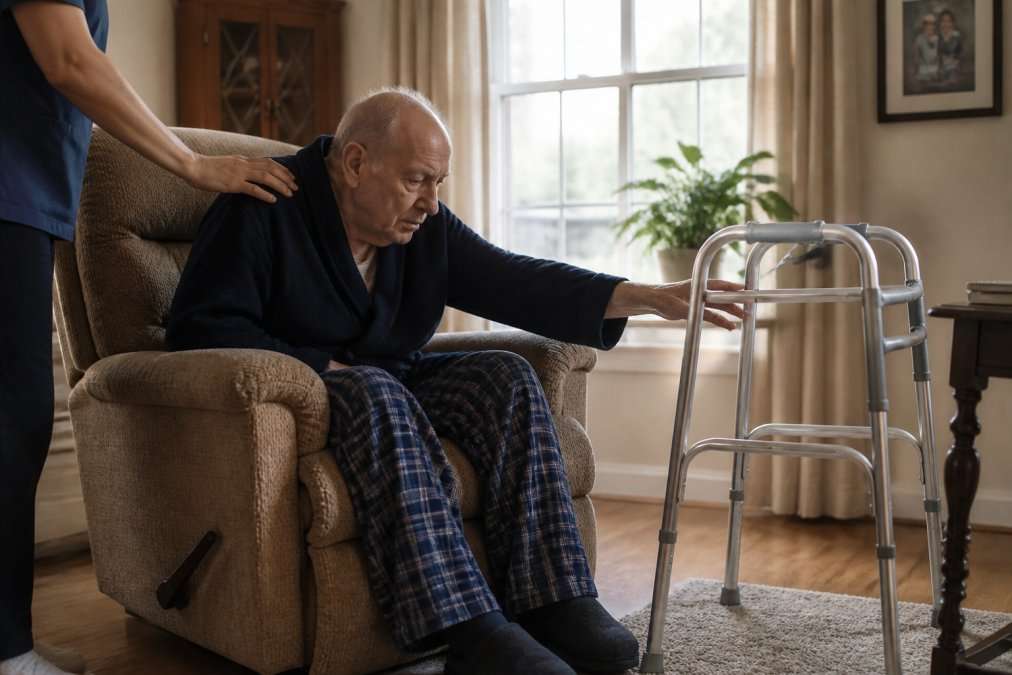
Knowing when to ask about hospice care can be difficult. Families often wait because they believe hospice is only for the final days of life or that asking about it means giving up.
Hospice is comfort-focused care for people with a terminal illness who meet specific eligibility requirements. It supports the patient while also providing education, emotional support and guidance to family caregivers.
No single symptom proves that someone qualifies for hospice. Eligibility is based on the underlying illness, the person’s overall pattern of decline and a physician-certified prognosis of six months or less if the illness follows its expected course.
The following signs do not establish eligibility by themselves. They may indicate that it is time to ask a physician, palliative-care provider or Medicare-certified hospice for an evaluation.
Signs It May Be Time to Ask About Hospice Care
The clearest signal is usually not one isolated symptom. It is a pattern: a serious progressive illness, continued decline despite treatment and a growing need for comfort and support.
1. The Serious Illness Continues to Progress
Hospice may be appropriate when a serious illness continues to advance despite treatment or when available treatments no longer provide meaningful benefit.
Conditions commonly associated with hospice care include:
- Advanced cancer
- Advanced heart disease
- Advanced lung disease
- Advanced dementia
- End-stage kidney or liver disease
- Progressive neurological conditions
- Other terminal illnesses
Eligibility is not based on the diagnosis alone. Physicians consider the disease stage, complications, functional decline, response to treatment and expected prognosis.
2. Hospital or Emergency-Room Visits Are Becoming More Frequent
Repeated trips to the hospital or emergency room may indicate that the illness is becoming more difficult to manage.
Families may notice:
- Multiple hospitalizations within several months
- Emergency visits for the same recurring problem
- Increasingly short periods of stability between hospital stays
- Each hospitalization leaving the person weaker
- The patient expressing that they no longer want repeated hospital treatment
There is no universal Medicare rule stating that a certain number of hospitalizations automatically qualifies someone for hospice. Repeated hospitalizations are one factor a physician may consider when evaluating the overall pattern of decline.
3. The Person Needs More Help With Daily Activities
Increasing dependence on others may be an important sign of functional decline.
A person may need more help with:
- Bathing
- Dressing
- Toileting
- Eating
- Getting in and out of bed
- Walking
- Taking medications
- Repositioning to prevent skin injuries
The change is particularly important when the person does not regain previous abilities after an illness or hospitalization.
4. Weakness and Falls Are Increasing
Progressive weakness, difficulty standing, reduced balance and repeated falls may show that the body is becoming less able to recover.
Families may notice that the person:
- Needs a walker or wheelchair more often
- Requires help transferring from the bed or chair
- Can no longer walk safely without assistance
- Has experienced repeated falls
- Spends most of the day in bed or a chair
- Becomes exhausted after minimal activity
Sudden weakness or an abrupt change in mobility should receive prompt medical evaluation. It may be caused by an infection, medication problem, stroke, dehydration or another potentially treatable condition.
5. Weight Loss or Reduced Eating Continues
Unintentional weight loss and a sustained decrease in eating may occur as a serious illness progresses.
Possible changes include:
- Eating much smaller portions
- Losing interest in meals
- Taking only a few bites
- Clothing becoming noticeably loose
- Progressive loss of muscle and strength
- Difficulty maintaining weight despite nutritional support
A change in appetite alone does not determine hospice eligibility. Physicians consider it together with the diagnosis, functional changes, complications and other evidence of decline.
6. Swallowing Has Become Difficult
Dysphagia means difficulty swallowing. Signs may include:
- Coughing or choking during meals
- A wet or gurgling voice after swallowing
- Food remaining in the cheeks
- Taking much longer to finish meals
- Recurrent aspiration or pneumonia
- Difficulty swallowing medications
Swallowing problems should be evaluated by a physician or qualified clinician. A speech-language pathologist may also assess swallowing safety and make recommendations.
7. Infections Are Becoming More Frequent
Recurring infections may indicate increasing medical vulnerability.
Examples include:
- Pneumonia
- Aspiration pneumonia
- Urinary tract infections
- Skin or wound infections
- Sepsis
- Infections that return soon after treatment
A physician should evaluate whether the infections are treatable and how they fit into the person’s overall condition, prognosis and goals.
8. Pain, Breathlessness or Other Symptoms Are Harder to Control
Hospice may be considered when symptoms related to the terminal illness become more frequent or difficult to manage.
These may include:
- Persistent pain
- Shortness of breath
- Nausea or vomiting
- Anxiety related to breathing or illness
- Agitation
- Fluid buildup
- Increasing need for symptom-management medications
- Repeated medical visits for uncontrolled symptoms
Sudden or severe breathing difficulty, chest pain, new confusion or other acute symptoms may require emergency medical attention. Families should not assume that every new symptom is an expected part of decline.
9. The Person Is Sleeping More or Becoming Less Engaged
A person with an advancing illness may sleep more, have less energy or show reduced interest in activities and conversation.
Families may notice:
- Longer or more frequent naps
- Less interest in visitors
- Reduced participation in activities
- Difficulty following conversations
- Less energy for personal care
- Spending most of the day resting
There is no specific number of sleeping hours that establishes hospice eligibility. A major or sudden change in alertness should be reported to a healthcare professional.
10. The Person’s Goals Have Shifted Toward Comfort
One of the most important signs may be a change in what the person wants from their care.
The patient may say:
- “I do not want to keep going back to the hospital.”
- “I want to stay at home.”
- “I want to be comfortable.”
- “I want to spend time with my family.”
- “The treatment is becoming harder than the illness.”
- “I want help controlling my symptoms.”
Hospice is not based only on symptoms. It also involves a decision to focus on comfort rather than Medicare-covered treatment intended to cure the terminal illness and related conditions.
Important: Some Changes Need Immediate Medical Attention
Do not automatically attribute a sudden decline to the natural progression of a terminal illness.
Seek prompt medical guidance for:
- Sudden confusion
- New facial drooping, weakness or difficulty speaking
- Severe or sudden breathing difficulty
- Chest pain
- A serious fall or possible head injury
- Uncontrolled bleeding
- Severe dehydration
- A sudden inability to swallow
- Symptoms of sepsis or another serious infection
The appropriate response depends on the person’s goals of care, advance directives and current care plan. When uncertain, contact the physician, hospice nurse if already enrolled, or emergency services.
Hospice Eligibility Requirements Under Medicare
Under the Medicare hospice benefit, a patient must have Medicare Part A and meet the applicable eligibility requirements.
The general requirements include:
- The hospice physician and the patient’s regular physician, if the patient has one, certify that the patient is terminally ill with a life expectancy of six months or less if the illness follows its expected course.
- The patient accepts comfort-focused care instead of Medicare-covered treatment intended to cure the terminal illness and related conditions.
- The patient signs a hospice election statement.
- Care is provided through a Medicare-certified hospice.
A six-month prognosis does not mean the patient must die within six months. A patient may continue receiving hospice beyond six months when the person remains eligible and the hospice physician properly recertifies the terminal prognosis.
How the Medicare Hospice Benefit Periods Work
The Medicare hospice benefit is organized into:
- A first 90-day benefit period
- A second 90-day benefit period
- An unlimited number of subsequent 60-day benefit periods
The patient must continue to meet hospice eligibility requirements. The hospice physician or medical director must recertify the terminal prognosis for the additional benefit periods.
The Face-to-Face Requirement
Before the third benefit period and before every subsequent benefit period, a hospice physician or hospice nurse practitioner must complete a face-to-face encounter with the patient.
The encounter documents clinical findings supporting continued eligibility. The nurse practitioner may perform the face-to-face evaluation, but the required physician is responsible for certifying or recertifying the terminal prognosis under Medicare’s rules.
The Four Levels of Medicare Hospice Care
Hospice is not one fixed service. Medicare recognizes four levels of hospice care, and the appropriate level may change as the patient’s needs change.
| Level | Purpose | Where Care Is Usually Provided |
|---|---|---|
| Routine home care | Standard hospice support when symptoms can be managed in the person’s residence | Private home, assisted living, memory care, residential care home or nursing facility |
| Continuous home care | Short-term, primarily nursing care provided during a symptom crisis to help the patient remain at home | A qualifying home setting—not an inpatient hospital, skilled nursing facility or hospice inpatient unit |
| Inpatient respite care | Short-term relief for the primary caregiver, generally for up to five consecutive days | Medicare-approved inpatient facility |
| General inpatient care | Short-term management of pain or symptoms that cannot reasonably be controlled in the current setting | Medicare-certified hospice inpatient facility, hospital or appropriately qualified nursing facility under arrangement with the hospice |
Hospice is primarily a service—not a specific building. In Central Texas, hospice may be provided in a private home, assisted living community, memory care community, residential care home or nursing facility when the setting and hospice arrangement support the required services.
What Medicare Hospice Covers
When related to the terminal illness and included in the hospice plan of care, covered services may include:
- Physician services
- Hospice nursing
- Medical social services
- Hospice aide services
- Counseling
- Spiritual support
- Medications for pain and symptom management
- Medical equipment and supplies
- Short-term inpatient symptom management
- Short-term inpatient respite care
- Dietary counseling
- Physical, occupational or speech therapy when included in the hospice plan of care
- Grief and bereavement support for the family
The hospice interdisciplinary team develops and updates the plan of care based on the patient’s needs and goals.
What Medicare Hospice Generally Does Not Cover
The Medicare hospice benefit generally does not cover:
- Treatment intended to cure the terminal illness or related conditions after the hospice election
- Medications unrelated to the terminal illness through the hospice benefit
- Care related to the terminal illness that was not arranged or approved by the hospice
- Ambulance transportation not arranged by the hospice for the terminal illness
- Room and board in an assisted living community, memory care community or nursing facility
- Around-the-clock custodial caregiving in the home
Original Medicare may continue covering medically necessary treatment for health conditions unrelated to the terminal illness and related conditions.
Families should ask the hospice to explain in writing:
- Which diagnosis and related conditions are included
- Which medications are covered
- Which equipment and supplies will be provided
- Which services remain outside the hospice benefit
- Who to contact before seeking hospital or emergency care
You Can Change Your Mind
Choosing hospice is not an irreversible decision.
A patient or authorized representative may revoke the hospice election. After revocation, the patient returns to the Medicare coverage available before hospice and may pursue treatment for the terminal illness.
If the patient later meets the requirements and wants hospice again, the patient may make a new hospice election.
Patients may also change hospice providers once during each benefit period by following Medicare’s required process.
Families should ask the hospice to explain the practical and financial effects before revoking or transferring care.
Palliative Care vs. Hospice Care
Palliative care and hospice both focus on comfort, symptom management and quality of life, but they are not the same.
| Feature | Palliative Care | Hospice Care |
|---|---|---|
| Who may receive it | People living with a serious illness at any stage | People with a terminal illness who meet hospice eligibility requirements |
| Prognosis requirement | No general six-month requirement | Six months or less if the illness follows its expected course |
| Treatment intended to cure the illness | May continue alongside palliative care | Under the Medicare hospice election, Medicare generally does not pay for treatment intended to cure the terminal illness and related conditions |
| Location | Hospital, clinic, medical office, facility or home | Wherever the patient lives, or an approved inpatient setting when medically necessary |
| Primary focus | Symptom relief, decision support and quality of life | Comfort, symptom management and support during a terminal illness |
Availability and insurance coverage for community-based palliative care vary. Families should confirm coverage directly with the provider and health plan.
How to Start a Hospice Conversation
A family does not have to wait for a physician to mention hospice.
The patient, family member, physician, hospital case manager, social worker, nurse or another healthcare professional may begin the conversation or contact a hospice for information.
However, a qualified physician must complete the required certification before Medicare hospice services begin.
A Script Families Can Use
“We have noticed several changes, including repeated hospital visits, increasing weakness and difficulty eating. We would like to discuss goals of care. Would you help us understand whether a hospice or palliative-care evaluation is appropriate?”
Other helpful questions include:
- “Based on the diagnosis and recent decline, what should we expect over the next several months?”
- “Would a hospice information visit be appropriate?”
- “Would palliative care help us manage symptoms and discuss goals?”
- “Which changes would indicate that hospice should be considered?”
- “Based on the person’s condition, prognosis and goals, what options should our family consider now?”
Who Can Start the Process?
Any of the following may begin the conversation or request information:
- The patient
- A legally authorized healthcare decision-maker
- A spouse or family member
- The primary-care physician
- A specialist
- A hospital case manager or social worker
- A nurse, therapist or other healthcare professional
- A hospice representative
A family may contact a hospice directly for information. The hospice can explain its services and evaluate the available clinical information, but physician certification is still required for Medicare hospice eligibility.
What Happens During a Hospice Evaluation or Admission?
The timing and process vary by agency, location, clinical urgency and the availability of required medical information.
A hospice clinician may:
- Review the diagnosis and medical history
- Assess symptoms and functional changes
- Discuss the patient’s goals and preferences
- Contact the appropriate physician for certification
- Explain the hospice election statement
- Review medications
- Develop an initial plan of care
- Arrange covered equipment or supplies
- Explain how to reach the hospice after hours
- Discuss caregiver responsibilities and available support
Families should not assume that hospice provides continuous bedside caregiving. Visit frequency and services depend on the plan of care, the patient’s needs and the applicable level of hospice care.
Documents to Have Ready
Helpful documents may include:
- Medicare card
- Insurance cards
- Photo identification
- Current medication list
- Contact information for physicians
- Recent hospital or emergency-room records
- Hospital discharge paperwork
- Advance directive, if one exists
- Medical power of attorney, if one exists
- Out-of-hospital Do Not Resuscitate order, if one has been completed
- Relevant laboratory, imaging or specialist reports
Advance directives and a medical power of attorney are not the same as an out-of-hospital DNR order. Families should discuss each document with the appropriate healthcare or legal professional.
If Hospice Eligibility Remains Uncertain
A physician may determine that the available information does not currently support a six-month prognosis.
If eligibility remains uncertain, families may:
- Ask what additional clinical information is needed
- Request a palliative-care consultation
- Ask the physician what changes should prompt reevaluation
- Request an evaluation from a Medicare-certified hospice
- Seek an appropriate medical second opinion
- Continue documenting hospitalizations, infections, weight loss, functional decline and symptom changes
Hospice eligibility is a clinical decision. A hospice agency cannot guarantee eligibility based only on a telephone conversation or symptom checklist.
Questions to Ask a Central Texas Hospice Agency
Before selecting a hospice, ask:
- Is the hospice licensed by Texas Health and Human Services?
- Is it Medicare-certified?
- Which Central Texas cities and counties does it serve?
- How quickly can a nurse respond in Austin, Round Rock, Georgetown, Cedar Park, Leander, Pflugerville, Buda, Kyle, San Marcos, New Braunfels, Bastrop, Temple, Belton, Killeen, Waco, Burnet or Marble Falls?
- Is clinical help available by phone 24 hours a day?
- How often should we expect visits from nurses, aides, social workers and chaplains?
- Which medications, equipment and supplies are covered?
- What should we do if symptoms worsen overnight?
- Where is general inpatient hospice care provided?
- How is inpatient respite care arranged?
- What support is available for family caregivers?
- How does the hospice coordinate with assisted living, memory care or nursing-facility staff?
- What services are not included?
- How are complaints or care concerns handled?
- Can we change hospice providers or revoke hospice later?
Ask for important coverage and service information in writing. Staffing models, geographic coverage and response procedures vary among agencies.
Texas Hospice Oversight
In Texas, hospice providers are licensed through Texas Health and Human Services as Home and Community Support Services Agencies under the hospice service category.
Texas HHS—not the Texas Department of Licensing and Regulation—oversees state hospice licensing.
Families can also use Medicare Care Compare to search for Medicare-certified hospice providers and review publicly available quality information.
Cultural, Spiritual and Family Beliefs
Hospice decisions may be shaped by cultural traditions, religious beliefs, family roles and personal values.
Families may want to ask:
- What does comfort mean to the patient?
- Where does the patient want to receive care?
- Which family members should participate in decisions?
- Are there religious or cultural practices the care team should understand?
- Does the patient want spiritual support?
- Which treatments remain consistent with the patient’s goals?
- Who has legal authority to make decisions if the patient cannot?
A good hospice team should listen respectfully and incorporate the patient’s values into the plan of care whenever possible.
Conclusion
The decision to ask about hospice should not depend on one symptom, one hospitalization or an online checklist.
The important pattern is a serious progressive illness, continued decline, increasing symptom burden and a shift toward comfort-focused goals.
Asking for a hospice evaluation does not require a family to enroll. It creates an opportunity to understand eligibility, services, coverage and whether hospice aligns with the patient’s wishes.
Earlier conversations allow families to make informed choices before another crisis or hospital discharge forces a rushed decision.
Frequently Asked Questions
What are 10 signs it may be time to ask about hospice?
Signs may include progression of a terminal illness, repeated hospital visits, increasing dependence with daily activities, worsening weakness or falls, continued weight loss, difficulty swallowing, recurring infections, uncontrolled symptoms, increased sleeping or withdrawal and a shift in goals toward comfort.
These signs do not independently establish eligibility. A qualified physician must evaluate the diagnosis, prognosis and overall pattern of decline.
Does a person have to be actively dying to receive hospice?
No. Medicare hospice eligibility is generally based on a physician-certified prognosis of six months or less if the illness follows its expected course, along with the patient’s election of comfort-focused hospice care.
A person does not have to be in the final days of life to receive hospice.
Can someone remain in hospice longer than six months?
Yes. Hospice is not limited to one six-month period. A patient may continue receiving hospice when the person remains eligible and the hospice physician properly recertifies the terminal prognosis.
Do two physicians always certify hospice eligibility?
At the beginning of the Medicare hospice benefit, the hospice physician and the patient’s regular physician, if the patient has one, certify the terminal prognosis. For later benefit periods, the hospice physician or medical director completes the required recertification.
Can a nurse practitioner certify someone as terminally ill?
A hospice nurse practitioner may perform the required face-to-face encounter before the third and subsequent benefit periods. The nurse practitioner’s findings support the recertification, but the applicable hospice physician completes the required physician certification or recertification.
Does Medicare hospice cover room and board?
Medicare generally does not pay room and board in assisted living, memory care or a nursing facility merely because the resident receives hospice.
Medicare may cover short-term inpatient respite care or general inpatient hospice care when the patient meets the applicable requirements.
Can someone receive treatment while enrolled in hospice?
A person may continue receiving care for health problems unrelated to the terminal illness and related conditions. Under the Medicare hospice election, Medicare generally does not pay for treatment intended to cure the terminal illness or related conditions.
The hospice should explain which diagnoses, medications and treatments are included in the plan of care.
Can someone leave hospice and return later?
Yes. A patient may revoke hospice and later elect it again if eligible. Families should ask how revocation may affect services and coverage before completing the process.
How is hospice different from palliative care?
Palliative care may be provided at any stage of a serious illness and may be combined with treatment intended to cure or control the disease. Hospice is intended for people with a terminal illness who meet specific eligibility requirements and elect comfort-focused care under the hospice benefit.
How do Central Texas families find a hospice provider?
Families can ask a physician, hospital case manager or social worker for options; search Medicare Care Compare; confirm Texas HHS licensing; and compare multiple Medicare-certified hospice agencies serving their area.
Senior Industry Services of Central Texas also provides educational information and a local provider directory to help families identify questions and explore available resources. SIS and Senior-AI do not determine hospice eligibility or provide medical advice.
Central Texas Hospice Resources
Senior Industry Services of Central Texas is a local resource hub connecting seniors, families, caregivers, healthcare professionals and senior-care providers with educational information and local resources.
The SIS Directory and Senior-AI can help families explore Central Texas hospice and palliative-care resources and prepare questions for physicians and providers. These resources are educational and do not replace medical, legal, financial, insurance or professional advice.
Reviewed by John Brown, CSA®
Senior Industry Services of Central Texas
Powered by Oasis Senior Advisors Austin & Central Texas
Sources and Resources
Medicare — Hospice Care Coverage
https://www.medicare.gov/coverage/hospice-care
Medicare — Medicare Hospice Benefits
https://www.medicare.gov/publications/02154-medicare-hospice-benefits.pdf
Medicare Care Compare — Hospice Services
https://www.medicare.gov/care-compare/?providerType=Hospice
Centers for Medicare & Medicaid Services — Hospice
https://www.cms.gov/medicare/payment/fee-for-service-providers/hospice
CMS — Medicare Benefit Policy Manual, Chapter 9: Coverage of Hospice Services
https://www.cms.gov/regulations-and-guidance/guidance/manuals/downloads/bp102c09.pdf
National Institute on Aging — What Are Palliative Care and Hospice Care?
https://www.nia.nih.gov/health/hospice-and-palliative-care/what-are-palliative-care-and-hospice-care
Texas Health and Human Services — Hospice Providers
https://www.hhs.texas.gov/providers/long-term-care-providers/hospice
Texas Health and Human Services — Home and Community Support Services Agencies
https://www.hhs.texas.gov/providers/long-term-care-providers/home-community-support-services-agencies-hcssa
Texas Health and Human Services — Advance Directives
https://www.hhs.texas.gov/regulations/forms/advance-directives
Senior Industry Services of Central Texas
https://seniorindustryservices.com/
This article provides general educational information and should not be interpreted as medical, legal, financial, insurance or benefits advice. Hospice eligibility, coverage, services and availability must be confirmed directly with the appropriate physician, health plan, government agency or hospice provider.